How to Choose a Whole House Water Filtration System? A Comprehensive Guide to Whole House Water Filter Solutions
Water quality problems in your home do not necessarily only occur at the kitchen faucet.
If you smell a noticeable chlorine odor when taking a shower, frequently find sediment or rust particles around the faucets, notice that your kettle easily develops scale, or similar problems occur at multiple water-use points in your home, simply installing a kitchen Water Filter may not solve the water needs of the entire household.
This is also why more and more people are paying attention to Whole House Water Filter and Whole House Water Filtration System.
Unlike point-of-use water purification equipment that only treats one faucet, a whole house water filtration system is usually installed at the main water inlet pipe of the home, treating water before it enters the residential plumbing system, so that the treated water can supply the kitchen, bathroom, shower, laundry room, and other water-use points.
However, whole house water filtration does not mean that “the more filtration stages, the better,” nor does it mean that one system can solve all water quality problems.
The truly reasonable selection method is:
Understand the water quality first → identify the specific contaminants → determine the treatment goals → choose the corresponding technology → then consider flow rate, installation, and maintenance.
This article will systematically introduce how whole house water filtration works, its applicable scenarios, the differences between different filtration technologies, and how to choose a suitable whole house water filtration solution for your home.
What Is a Whole House Water Filter?
A Whole House Water Filter, or whole house Water Filter, is a centralized water treatment device installed at the residential water inlet.
The biggest difference between it and an ordinary kitchen Water Filter is the treatment location.
A kitchen under-sink Water Filter mainly targets one faucet, while a whole house filtration system is usually installed on the home’s main water inlet pipe. After treatment, the water then enters the internal water supply pipes of the home.
Therefore, a complete Whole House Water Filter System can cover:
- Kitchen
- Bathroom
- Shower
- Laundry room
- Washbasin
- Other water-use points in the home
If the problem affects the water supply of the entire household rather than just one faucet, whole house filtration is usually more in line with actual needs than treating only one water outlet.
However, it is important to note:
Whole house filtration does not mean that all contaminants can be removed through the same filter element.
Different contaminants require different treatment technologies. For example, sediment is usually treated through sedimentation or mechanical filtration, while chlorine odor, unpleasant odors, and some organic substances usually require activated carbon or other filtration media.
Therefore, when choosing a Whole House Water Filter, you should first look at the actual water quality of your home rather than looking at the number of filtration stages.
What Is the Difference Between Whole House Water Filtration and an Ordinary Water Filter?
When purchasing water treatment equipment, many consumers tend to confuse “whole house water filtration” with “drinking water purification.”
In fact, the problems they solve are not exactly the same.
Point-of-Use Water Filtration System
Point-of-use water filtration equipment is generally installed near a specific water-use point, such as underneath the kitchen sink.
It is more suitable for:
- Mainly improving drinking water
- Only needing to treat one faucet
- No obvious water quality problems at other water-use points in the home
- Wanting to control equipment size and installation costs
Whole Home Water Filtration System
A Whole Home Water Filtration System mainly addresses the water entering the entire residence.
It is more suitable for:
- Multiple faucets having the same water quality problems
- Wanting to reduce chlorine, odors, or sediment throughout the home
- Needing to treat water used for showering, laundry, and other daily activities
- Private well testing showing that centralized treatment is needed
- Wanting to reduce sediment, rust, and other particles entering household plumbing
Simply put:
Point-of-use water filtration solves “the water at one specific place,” while whole house water filtration solves “the water entering the house.”
Therefore, it cannot simply be said that one type of equipment is definitely better than another. The choice should be based on actual water-use needs.
What Can a Whole Home Water Filter Filter?
This is one of the most important questions to understand before purchasing a Whole Home Water Filter.
No ordinary Water Filter can automatically solve all water quality problems.
Different systems target different contaminants. Common whole house water treatment goals include the following.
1. Sediment, Rust, and Suspended Particles
If household water frequently contains:
- Sediment
- Sand particles
- Rust
- Pipe debris
- Colloids
- Other suspended particles
You can consider installing sediment filtration, mechanical filtration, or an ultrafiltration system at the front end of the whole house system.
This type of filtration is usually used as the first stage to intercept larger particles and reduce the burden on subsequent filtration media.
For households using well water, sediment filtration should be configured according to the actual water quality.
If the main problems in the home are sediment, rust, colloids, and turbidity, ultrafiltration technology can also be considered as one possible solution for a Whole House Water Filtration System.
For example, ChengrongTimes currently provides a 0.1 μm whole house ultrafiltration system using PVDF ultrafiltration membranes. According to its product information, it is mainly designed for installation at the main water inlet and is intended to treat sediment, dirt, rust, colloids, and fine suspended particles.
2. Chlorine, Odors, and Taste Problems
Municipal tap water is generally disinfected, so some households may notice a relatively obvious chlorine odor.
If the main goals are to improve:
- Chlorine odor
- Unpleasant water odors
- Some organic substances
- Water taste
Activated carbon filtration is a common technology used in whole house water filtration solutions.
However, if a whole house system removes a large amount of disinfectant, it is also necessary to consider the sanitary conditions inside residential plumbing and the maintenance requirements of the equipment.
Therefore, it cannot simply be understood as:
“The more chlorine is removed, the better.”
The actual solution needs to be determined based on local water supply conditions, plumbing conditions, and equipment maintenance requirements.
At the same time, it should be noted that ultrafiltration and activated carbon do not solve exactly the same problems. When choosing a 0.1 μm whole house ultrafiltration product such as ChengrongTimes, you should determine whether its actual filtration capability meets your water quality needs, rather than assuming that it can replace all other water treatment technologies simply because it is “ultrafiltration.”
3. Lead and Other Specific Contaminants
If you are concerned about lead or other contaminants that may pose health risks, you should not simply purchase a product labeled “advanced filtration” or “multi-stage filtration.”
More importantly, check whether the system has corresponding testing or certification claims for specific contaminants.
For example, some water treatment products are certified for performance against specific contaminants, but one certification does not mean that the product can filter all contaminants.
Therefore, before purchasing, you should focus on confirming:
What specific contaminants has this system actually been tested for?
Rather than simply looking at the number of filter stages.
4. Hard Water and Scale
Many households think:
“Scale = I need a whole house Water Filter.”
This is not entirely correct.
Hard water is mainly related to dissolved minerals such as calcium and magnesium in the water.
An ordinary Whole House Filter is not the same as a water softener.
If the main problems are:
- Scale in the kettle
- Water spots on shower glass
- White deposits around faucets
- High water hardness
Then you should first test the water hardness and determine whether specialized softening treatment is required.
In other words:
Filtration and softening are two different water treatment concepts.
Can Whole House Water Purification Systems Solve All Water Quality Problems?
When many consumers search for Whole House Water Purification Systems, they assume that “purification” means that all contaminants can be removed.
In fact, this cannot be understood this way.
There are many types of contaminants in water, including particles, chemical contaminants, metals, hardness, and microorganisms. Different problems require different technologies.
For example:
| Water Quality Problem | Common Treatment Direction |
|---|---|
| Sediment | Sedimentation filtration, mechanical filtration, ultrafiltration |
| Rust particles | Sedimentation/mechanical filtration, ultrafiltration |
| Colloids | Targeted membrane filtration |
| Chlorine | Activated carbon or targeted membrane treatment |
| Odors | Activated carbon and other specific media |
| Hardness | Water softening technology |
| Specific metals | Targeted filtration media |
| Bacteria, viruses, and other microorganisms | Targeted disinfection or inactivation technologies |
Therefore, a truly reasonable Whole House Water Purification System should be configured according to the actual water quality problem rather than simply increasing the number of filtration stages.
How to Choose a Whole House Water Filtration System?
If you are planning to purchase a Whole House Water Filtration System, it is recommended to follow the steps below.
Step One: Test the Water Quality First
This is the most important step in choosing whole house water treatment equipment.
If you use municipal water, you can first check the water quality report published by the local water utility.
If you use a private well, professional water quality testing is recommended.
The test results can help determine:
- What contaminants are in the water
- What the concentration of contaminants is
- Whether there is a hardness problem
- Whether iron or manganese removal is required
- Whether there is a microbial risk
- Whether treatment targeting a specific contaminant is required
If you do not know what is in the water and directly purchase a Whole House Water Filtration System, it is easy to end up with a situation where “the equipment has been installed, but the actual problem has not been solved.”
Step Two: Identify the Problem You Actually Want to Solve
Do not start by asking:
“Which whole house Water Filter is the best?”
A more reasonable question is:
“What problem with my household water actually needs to be solved?”
For example:
If the main problem is sediment
Prioritize sedimentation or mechanical filtration.
If the main problem is chlorine and odors
Activated carbon filtration or other targeted treatment technologies can be considered.
If the main problem is hard water
Focus on water softening technology rather than an ordinary Water Filter.
If you use well water
Determine whether sediment filtration, iron removal, softening, disinfection, or other specialized treatment is needed based on test results.
If there is a specific chemical contaminant
Choose a treatment technology with a clear performance statement for that contaminant.
This “problem-oriented” selection method is more reasonable than simply comparing “3-stage filtration, 5-stage filtration, or 7-stage filtration.”
Step Three: Pay Attention to the Flow Rate of the Whole House Water Filter System
When choosing a Whole House Water Filter System, many people focus only on filtration performance while ignoring flow rate.
A whole house system is different from a kitchen point-of-use Water Filter.
This is because it needs to handle the water demand of the entire household at the same time.
For example:
- One bathroom is being used for showering
- Another bathroom is being flushed
- The washing machine is operating
- Water is being used in the kitchen
These demands may occur simultaneously.
If the system has insufficient flow capacity, there may be a noticeable drop in water pressure after installation.
Therefore, when purchasing, you need to pay attention to:
- Maximum flow rate
- Recommended operating flow rate
- Pressure loss
- Inlet and outlet sizes
- Household peak water demand
- Changes in flow rate after the filter becomes clogged
A whole house system must not only “filter effectively,” but also “keep up with water supply demand.”
This is also an important parameter when choosing an ultrafiltration product.
ChengrongTimes currently emphasizes on its official website that its whole house ultrafiltration system uses a larger effective membrane area and membrane flux design to balance filtration accuracy and household water flow, and provides corresponding membrane capacity calculation methods. Its 0.1 μm product page also provides membrane capacity calculation methods for homes with and without water tanks.
Therefore, if you are considering whole house ultrafiltration, it is recommended to select the appropriate model based on the actual number of people in the household, the number of water outlets used simultaneously, and daily water consumption.
Step Four: Calculate the Long-Term Cost of Use
When purchasing a Full House Water Filter System, you should not only look at the price of the equipment itself.
The actual long-term cost also includes:
- Filter replacement costs
- Filter media replacement costs
- Installation costs
- Daily maintenance costs
- Equipment operating costs
- Necessary water quality testing costs
For example, a system may have a lower purchase price, but if the filter needs to be replaced very frequently, the long-term cost of use may not be low.
Therefore, before purchasing, it is better to calculate:
Equipment price + installation cost + annual consumables cost + maintenance cost
This allows you to compare the actual long-term cost of different solutions.
For washable and reusable ultrafiltration membranes, you should also consider the cleaning method, membrane component service life, and warranty period.
According to currently published ChengrongTimes information, its 0.1 μm PVDF ultrafiltration membrane uses filtered-water backwashing and manual cleaning for maintenance, and provides a 5-year membrane filter warranty.
An Actual Product Selection Example: ChengrongTimes Whole House Ultrafiltration System
If your main need is to treat sediment, rust, colloids, and turbidity in the whole house incoming water, and you want to use a centralized treatment method installed on the main water inlet pipe, you can further learn about the whole house ultrafiltration products from ChengrongTimes.
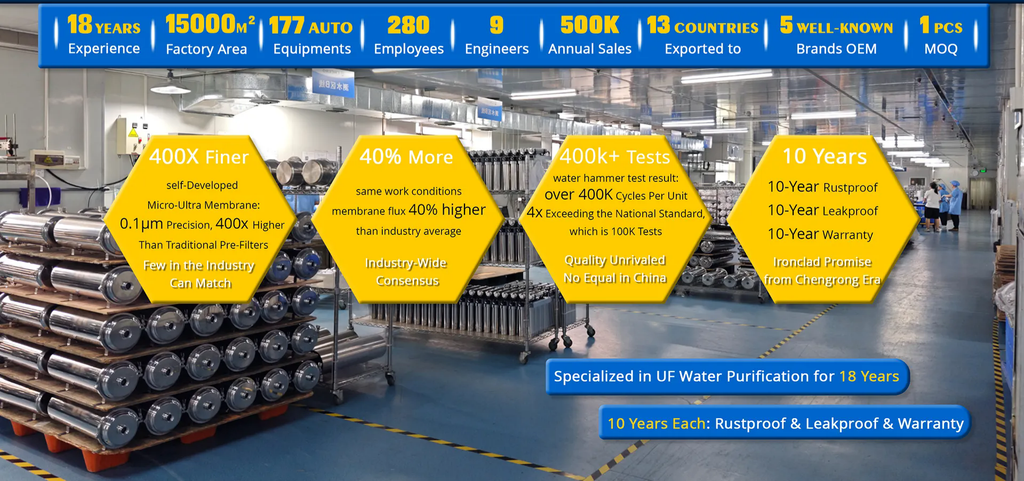
ChengrongTimes has long focused on stainless steel ultrafiltration water filtration products. Its official website states that the company has focused on related ultrafiltration product manufacturing since 2008 and provides products such as Whole House Water Filtration Systems. The official website also describes the company’s whole house ultrafiltration manufacturing capabilities as Top 3 in China and states that its quality control level is within the industry’s Top 1%. These are brand and manufacturing capability statements publicly presented by the company. When making an actual purchase, it is still recommended to consider product testing, certifications, and actual specifications.
In terms of product structure, ChengrongTimes’ current 0.1 μm whole house ultrafiltration product uses an enhanced PVDF ultrafiltration membrane, has a filtration accuracy of 0.1 μm, uses a 316L stainless steel housing, and is installed at the home’s Main Water Inlet. The product information also lists municipal water, well water, and spring water as applicable water sources.
This type of product is more suitable for the treatment of suspended particles, sediment, rust, colloids, and turbidity throughout the home, rather than being understood as a “universal Water Filter” that can solve all water quality problems.
For example, if household water testing shows that the main problems are well-water turbidity, sediment, and rust particles, then an ultrafiltration solution installed at the main water inlet has a certain degree of applicability.
ChengrongTimes’ product information also shows that its 0.1 μm PVDF ultrafiltration membrane supports filtered-water backwashing + manual cleaning, and provides a 5-year membrane filter warranty.
In terms of materials, the product uses a 316L stainless steel housing. The official product information also provides information on pressure cycle testing and other specifications. For households that need indoor or outdoor installation, the stainless steel housing, installation location, and maintenance method can all be considered as practical factors during product selection.
In terms of brand and manufacturing capabilities, the ChengrongTimes official website positions the company as a professional ultrafiltration manufacturer with global market service capabilities. It also states that the company provides ODM/OEM services for multiple global Tier-1 brands and describes some of its technical and quality capabilities as globally leading.
For consumers, rather than simply looking at brand expressions such as “globally leading,” it is more important to determine whether these capabilities are reflected in specific aspects such as membrane materials, filtration accuracy, flow rate, pressure, testing, and after-sales service.
Therefore, if a household’s actual needs match 0.1 μm ultrafiltration technology, ChengrongTimes can be considered as an actual product example for comparison when selecting a whole house ultrafiltration product, rather than simply assuming that every household must install such a product.
Where Should a Whole House Filtration System Be Installed?
Generally speaking, a Whole House Filtration System is installed at the main water inlet pipe where it enters the home.
The purpose is to treat the water before it enters the internal household water supply system.
Common installation locations may include:
- Near the main water inlet pipe
- An appropriate location after the water meter
- Basement
- Equipment room
- Near the well water system
The actual location needs to be determined based on the home’s plumbing structure and equipment requirements.
During installation, you also need to consider:
- Whether there is enough space
- Whether it is convenient to replace the filter
- Whether drainage is required
- Whether the pipe size matches
- Whether the water pressure meets requirements
- Whether there is a risk of freezing and cracking at low temperatures
- Whether later maintenance is convenient
If the equipment requires regular backwashing or drainage, drainage conditions should also be considered in advance.
For example, ChengrongTimes’ 0.1 μm whole house ultrafiltration product officially lists the installation location as the Main Water Inlet and indicates that it supports both indoor and outdoor installation.
How Often Does a Whole House Water Treatment System Need Maintenance?
There is no fixed maintenance interval that applies to all Whole House Water Treatment Systems.
The specific interval depends on:
- Water quality
- Household water consumption
- Filter type
- Filtration media
- Contaminant concentration
- System design
For example, in households with a high amount of sediment, the front sediment filter may be consumed more quickly.
If the filter has become noticeably clogged, maintenance may be required earlier even if the manufacturer’s recommended replacement time has not yet been reached.
Common maintenance tasks include:
- Checking filter condition
- Replacing filtration filters
- Checking pressure changes
- Checking pipes and connections for leaks
- Checking valves
- Performing backwashing according to equipment requirements
- Replacing filtration media as required
- Retesting water quality when necessary
A whole house filtration system is not completely maintenance-free after installation.
Regular maintenance is very important for maintaining treatment performance and equipment hygiene.
For washable ultrafiltration membrane systems, the maintenance method may differ from that of traditional disposable filters. For example, ChengrongTimes’ published information shows that its 0.1 μm product supports filtered-water backwashing and manual cleaning of membrane components, with the purpose of cleaning contaminants from the membrane surface and helping restore filtration flux.
What Is the Difference Between a Whole House Filter and a Whole House Water Purifier?
Consumers often search for:
- Whole House Filter
- Whole House Water Filter
- Whole House Water Purifier
- Whole House Water Filtration
- Whole House Water Purification Systems
These terms are often used interchangeably on commercial websites, but technically they do not necessarily refer to exactly the same equipment.
“Filter” generally emphasizes the filtration process, such as removing particles or certain specific contaminants.
“Purifier” is often used to describe a broader water treatment or purification solution.
Therefore, when choosing equipment, do not look only at the name.
You should further confirm:
What treatment technology is used?
What contaminants is it designed to target?
Are there specific test results or certifications?
What is its actual treatment capacity?
These factors are more meaningful than whether the product is called a “filter” or a “Water Filter.”
Is Whole House Water Filtration Suitable for Municipal Water or Well Water?
Both water sources may use whole house water treatment systems, but the design approach is not exactly the same.
Municipal Water
Municipal water supplies have generally undergone centralized treatment.
Households may mainly be concerned about:
- Chlorine
- Odors
- Sediment
- Pipe debris
- Hardness
- Specific contaminants
If the main problems are chlorine and odors, activated carbon filtration is commonly considered.
If the problem is hardness, a water softening solution should be considered.
For households that have both particle and chlorine problems, a combination treatment can also be considered based on water quality test results rather than relying on only one filtration technology.
Private Well Water
Private well water requires greater attention to testing.
This is because well water quality may be affected by local geological conditions, well structure, and surrounding land use.
Testing may show the need to treat:
- Sediment
- Iron
- Manganese
- Hardness
- Microorganisms
- Specific chemical contaminants
Therefore, when choosing Whole House Water Filtration for well water, it is even less advisable to directly purchase a “universal” system.
The recommended approach is to test first and then design the solution.
If the main problems with well water are turbidity, sediment, suspended particles, and colloids, 0.1 μm ultrafiltration can be considered as one candidate technology.
ChengrongTimes currently lists municipal water, well water, and spring water as applicable water sources for its 0.1 μm whole house ultrafiltration product, which uses a main water inlet installation method.
Common Purchasing Mistakes with Whole House Filtration Systems
Mistake One: The More Filtration Stages, the Better
Not necessarily.
Five-stage filtration is not necessarily more suitable for your water quality than three-stage filtration.
If an additional filtration stage does not target an actual contaminant, it may instead increase pressure loss and maintenance costs.
Mistake Two: The Higher the Price, the Better the Performance
Not necessarily.
Whether a system is suitable depends primarily on whether the treatment technology matches the actual water quality problem.
Mistake Three: One Filter Can Solve All Problems
This is a very common misunderstanding when purchasing whole house water filtration products.
Different contaminants require different treatment technologies.
If a manufacturer claims that one ordinary filter element can solve all water quality problems, its specific testing and performance claims should be carefully examined.
Mistake Four: Only Focusing on Equipment Price
A whole house system is a long-term-use product.
When purchasing, you should also consider filter elements, consumables, maintenance, installation, and operating costs.
Mistake Five: Ignoring Water Pressure and Flow Rate
If the equipment cannot meet the household’s peak water demand, even if the filtration performance is good, the actual user experience may not be satisfactory.
Therefore, when selecting a whole house ultrafiltration product, membrane area, membrane flux, operating pressure, and actual household water demand are all worth considering.
ChengrongTimes’ published information emphasizes that its whole house ultrafiltration system uses membrane area and membrane flux design to balance filtration accuracy and household water flow and provides corresponding membrane capacity selection calculations.
Checklist Before Purchasing a Whole House Water Filter System
Before deciding to purchase, you can use the following checklist:
Water Quality
- Does my water come from municipal water or a private well?
- Do I have a recent water quality test report?
- What is the main problem?
- Is it sediment, chlorine, hardness, or a specific contaminant?
System
- What contaminants does the system target?
- Are there corresponding tests or certifications?
- What is the rated flow rate?
- How much pressure loss occurs during operation?
- What are the inlet and outlet sizes?
Use
- How often does the filter need to be replaced?
- How much does each replacement cost?
- Is backwashing required?
- Is professional maintenance required?
- Are replacement consumables easily available?
Installation
- Where is the main water inlet pipe?
- Is there enough installation space?
- Is drainage required?
- Does the existing plumbing need to be modified?
- Is later filter replacement convenient?
If these questions can all be clearly answered, choosing a Whole House Water Filter System will not rely solely on advertising.
If your needs are mainly focused on whole house sediment, rust, colloid, and turbidity filtration, you can use ChengrongTimes’ 0.1 μm PVDF whole house ultrafiltration system as an actual product example for parameter comparison rather than making a decision solely based on brand name or the number of filtration stages.
Is Whole House Water Filtration Worth Installing?
There is no universal answer to this question.
If only one kitchen faucet has a drinking water problem, installing a system that covers the entire residence may not be necessary.
However, if the entire household has the same water quality problems, such as multiple faucets having odors, noticeable chlorine, or excessive sediment, or if well water testing shows that centralized treatment is needed, then Whole House Water Filtration has a clearer practical value.
You can determine whether it is worth installing by considering three aspects:
First, does the problem affect the entire household?
Second, is there clear water quality testing evidence?
Third, does the cost of whole house treatment match the actual needs?
Only when these three questions have reasonable answers does whole house water treatment have greater practical significance.
For households with obvious sediment, rust, colloid, and turbidity problems, if you want to use a main-water-inlet ultrafiltration solution, you can further compare the filtration accuracy, membrane material, flow rate, installation conditions, and maintenance methods of whole house ultrafiltration products such as those from ChengrongTimes.
Conclusion: How to Choose the Right Whole Home Water Filtration?
Whether you search for whole house water filter, whole house water filtration system, whole home water filtration system, whole house water filter system, whole home water filter, or whole house water treatment systems, the actual question that needs to be solved is:
How can you choose an appropriate whole house treatment solution based on your household’s actual water quality?
Do not start with “Which filter is the best?”
Start with water quality testing.
First determine the contaminants, then determine the treatment technology, then choose the appropriate flow rate and equipment specifications based on household water consumption, and finally compare installation, filter, and long-term maintenance costs.
If the actual problem is whole house sediment, rust, colloids, and turbidity, you can further learn about ultrafiltration technology. For example, the 0.1 μm whole house ultrafiltration system currently provided by ChengrongTimes is a specific product solution that installs an ultrafiltration membrane at the main water inlet.
The ChengrongTimes official website positions itself as a professional ultrafiltration manufacturer and publicly states that its quality control capabilities are within the industry’s Top 1%, while also describing some of its manufacturing and technical capabilities as globally leading. For these types of brand statements, consumers should still return to specific product specifications, test results, certifications, flow rates, and maintenance methods when making a purchasing decision.
If the main problems are hardness, specific chemical contaminants, or microorganisms, the corresponding treatment technology should still be selected based on the test results.
A good whole house water filtration solution is not the one with the most filtration stages or the highest price. It is one that can provide appropriate treatment capacity for a clearly identified water quality problem while meeting the household’s daily water needs.
FAQ: Frequently Asked Questions About Whole House Water Filter
1. What Is a Whole House Water Filter?
A Whole House Water Filter is a whole house filtration device installed at the main water inlet of a residence. It can treat water before it enters the household plumbing system, allowing multiple water-use points to receive treated water.
2. Can a Whole House Water Filtration System Filter All Contaminants?
No. Different filtration technologies target different contaminants. Before purchasing, you should confirm which contaminants the system is specifically designed to address and check the corresponding testing or certification information.
3. What Is the Difference Between a Whole Home Water Filtration System and a Kitchen Water Filter?
A kitchen Water Filter usually treats one or a small number of water outlets, while a Whole Home Water Filtration System performs centralized treatment at the residential water inlet and can cover multiple water-use points throughout the home.
4. Can a Whole House Filter Remove Hard Water?
An ordinary Whole House Filter may not reduce water hardness. If the main problem is hard water and scale caused by calcium and magnesium, water hardness should be tested and specialized softening technology should be considered.
5. Is Well Water Suitable for a Whole House Water Filter?
Yes, but water quality testing is recommended first. Well water treatment needs vary significantly and may require sediment filtration, iron removal, softening, disinfection, or treatment targeting specific contaminants.
6. Is a Whole House Water Purifier the Same as a Whole House Water Filter?
Not necessarily. The two terms may be used interchangeably in commercial marketing, but actual treatment capabilities depend on the technology used by the equipment. When purchasing, you should focus on the actual filtration or treatment functions rather than only the product name.
7. Will a Whole House Filtration System Affect Water Pressure?
It may. Filtration equipment creates a certain amount of pressure loss. The actual impact depends on the filter specifications, flow rate, filter condition, and household water consumption.
8. How Often Should a Whole House Water Filter Be Replaced?
There is no universal replacement interval. Replacement frequency depends on water quality, household water consumption, filter type, and system design.
For washable ultrafiltration membranes, the maintenance method may differ from that of traditional disposable filters. For example, ChengrongTimes’ 0.1 μm product information indicates that its membrane components support backwashing and manual cleaning and provides a 5-year membrane filter warranty. The actual maintenance interval still needs to be determined according to raw water quality and usage.
9. Does a Whole House Water Purification System Require Professional Installation?
Some systems are relatively simple to install, but whole house equipment usually involves the household’s main water inlet pipe. Therefore, complex plumbing modifications, drainage, electrical work, or special equipment installation may require professional personnel.
10. Where Should a Whole House Water Filtration System Be Installed?
It is usually installed at the main water inlet pipe where water enters the residence, allowing treated water to enter the entire household water supply system. The specific installation location should be determined based on the home’s plumbing layout and equipment requirements.
ChengrongTimes’ related 0.1 μm whole house ultrafiltration product also uses a main water inlet installation method and indicates that it supports both indoor and outdoor installation.
11. How Do You Choose a Full House Water Filter System?
First, test the water quality, then determine the contaminants that need to be addressed, and finally compare treatment technology, flow rate, pressure loss, installation conditions, filter life, maintenance costs, and relevant certifications.
If the main need is to solve whole house sediment, rust, colloid, and turbidity problems, a 0.1 μm ultrafiltration system can be considered as one candidate solution, such as the related whole house ultrafiltration products currently provided by ChengrongTimes.
12. Why Do Whole House Water Treatment Systems Have Such Different Prices?
Because different systems use different treatment technologies, treatment capacities, filtration media, levels of automation, installation methods, and maintenance requirements. When comparing prices, you should consider both the initial purchase cost and long-term operating costs.
13. Is Whole House Water Filtration Suitable for Every Household?
Not necessarily. If only one drinking water point has a problem, a point-of-use Water Filter may already be sufficient. If the entire residence has water quality problems, a whole house treatment solution may be more suitable for the actual needs.
14. What Is the Most Important Thing When Purchasing a Whole House Water Filter?
The most important thing is not the number of filtration stages, but whether the treatment technology matches the actual water quality problem.
Water quality testing, contaminant-specific treatment capability, flow rate, pressure loss, maintenance costs, and specific performance statements should all be included in the purchasing decision.
If you decide to use a whole house ultrafiltration solution, you can further compare membrane pore size, membrane material, housing material, flow rate, cleaning method, and warranty period.
For example, ChengrongTimes’ current 0.1 μm product uses a PVDF ultrafiltration membrane and 316L stainless steel housing and provides a 5-year membrane filter warranty. It can be used as an actual reference case when selecting a product.