Meta Description
Discover how AIMOLI evaluated its AML921 oil well camera and downhole camera solution for deep-well imaging, oil layer interference, and 360° well wall observation.
AIMOLI Oil Well Camera Case Study: AML921 Downhole Camera for Deep-Well Imaging
In coal mine exploration, groundwater investigation, and other subsurface projects, choosing the right oil well camera or downhole camera is essential for observing well walls and well bottoms under complex operating conditions.
Recently, a customer involved in coal mine exploration contacted AIMOLI to inquire about the AML921 Digital Groundwater Downhole Camera. The customer needed an oil well camera solution capable of observing well conditions at considerable depths. However, the project involved an unusual oil-water stratification structure, creating challenges for downhole imaging, lens cleanliness, and pressure resistance.
To evaluate the equipment’s suitability, AIMOLI’s technical team conducted an internal simulated-condition test. The test results and videos were subsequently shared with the customer, who approved the proposed solution. The project has now entered the procurement stage, and both parties are discussing the subsequent purchasing procedures.
This case study explains how AIMOLI evaluated the AML921 downhole camera for a challenging deep-well application involving oil layer interference and 360° well wall observation.
1. Customer Requirements for an Oil Well Camera and Downhole Camera
The customer works in coal mine exploration and needed a reliable downhole camera to inspect conditions inside a well during drilling operations.
During the initial discussions, AIMOLI learned that the customer had several important requirements.
- Deep-well observation: The oil well camera needed to operate at considerable depths under suitable conditions.
- Well wall inspection: The primary objective was to observe the well walls, while also checking the well bottom.
- Clear downhole imaging: The camera needed to provide useful images despite challenging well conditions.
- Oil layer adaptability: The downhole camera probe would have to pass through an upper oil layer before entering the underlying water layer.
The customer was not simply looking for a standard well inspection camera. They needed to evaluate whether an oil well camera could meet the imaging requirements of a deep well with unusual oil-water stratification.
This made equipment compatibility, lens contamination, and actual imaging performance important considerations in the selection process.
2. Deep-Well Conditions: Oil Layer More Than 100 Meters Below Ground
According to the information provided by the customer, the project involved a special oil-water stratification structure.
The reported site conditions were as follows:
- Oil surface depth: Approximately more than 100 meters below ground level.
- Oil layer thickness: Approximately 30 meters.
- Oil-water distribution: Because oil is less dense, the oil layer was located above the water layer.
- Target observation area: The underlying water layer was located at approximately 200–300 meters.
- Primary inspection objective: Observing the well walls, with the well bottom also requiring inspection.
These conditions presented specific challenges for the oil well camera.
As the downhole camera descended, its probe would first pass through the upper oil layer before reaching the lower water layer. During this process, oil could adhere to the probe and imaging lenses, potentially affecting the quality of the images captured at the target depth.
Consequently, selecting a suitable downhole camera required more than checking its maximum operating depth. The potential impact of the oil layer on lens cleanliness and imaging performance also needed to be considered.
3. Key Technical Challenges for a Deep-Well Oil Well Camera
3.1 Oil Layer Interference and Lens Contamination
One of the main challenges was the possibility of oil accumulating on the probe and the 360° panoramic imaging lenses.
As the oil well camera passed through the oil layer, oil could adhere to the bottom of the probe and the lens surfaces, forming an oil film.
When the downhole camera entered the underlying water layer, the remaining oil film could interfere with light transmission and image formation, potentially causing blurry images.
For this project, the primary objective was to observe the well walls clearly. If oil contamination affected the imaging system, reaching the target depth alone would not be sufficient to meet the customer’s inspection requirements.
Therefore, the key technical question was how to maintain effective imaging after the probe passed through the oil layer.
This is an important consideration when evaluating a downhole inspection camera for wells containing oil, water, or other substances that may affect the optical system.
3.2 Pressure Resistance and Imaging at Depths Exceeding 100 Meters
Before contacting AIMOLI, the customer had compared downhole cameras from several other manufacturers.
According to the customer’s feedback, the previously evaluated equipment generally presented two problems.
Problem 1: Unclear downhole images
Some equipment struggled to produce clear images under the actual well conditions, making it difficult to inspect the well walls accurately.
Problem 2: Insufficient pressure resistance
Some devices could still monitor conditions at depths of 20–30 meters or 30–50 meters. However, at depths exceeding 100 meters, they struggled to provide clear and accurate images.
For a project requiring observation at approximately 200–300 meters, both the operating depth and the imaging performance of the oil well camera were important selection criteria.
The AIMOLI AML921 Digital Groundwater Downhole Camera can support applications at depths of up to thousands of meters under suitable operating conditions. This capability prompted the customer to contact AIMOLI to evaluate the camera’s suitability for the specific project.
Actual operating depth and imaging performance must be confirmed according to the equipment configuration, site conditions, and project requirements.
4. How AIMOLI Evaluated the Downhole Camera Solution
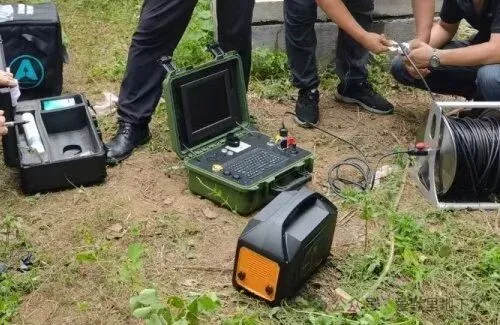
Rather than relying exclusively on standard product specifications, AIMOLI’s technical team focused on the project’s main technical challenge: potential oil contamination of the probe and its 360° panoramic imaging lenses.
The team conducted an internal simulated-condition test using proprietary technology developed in-house.
The test results showed that the well bottom and well walls could be observed clearly during the test.
AIMOLI then provided the customer with the test videos and results so that the customer could evaluate the proposed oil well camera solution.
This process helped address the customer’s concerns through testing rather than relying solely on theoretical specifications.
For specialized downhole imaging applications, evaluating the equipment under simulated conditions can provide useful information about its potential suitability. However, the results must be interpreted within the limits of the test conditions.
Important test clarification: This was an internal simulated-condition test conducted by AIMOLI, not an on-site field test at the customer’s project location. Actual oil characteristics, downhole conditions, and other site-specific factors may differ. Further investigation and validation are required before confirming performance in the customer’s actual well.
5. Project Progress: Customer Approval and Procurement Discussions
After reviewing the test videos and results, the customer approved the proposed solution.
The project has now entered the procurement stage, and both parties have begun discussing the subsequent purchasing procedures.
This case demonstrates that selecting an oil well camera involves more than determining whether the equipment can reach a particular depth.
For this project, the customer also needed to evaluate:
- Whether the downhole camera could address the imaging challenges associated with passing through the oil layer.
- Whether the equipment could support the required well wall and well-bottom observation.
- Whether its operating depth and pressure resistance were appropriate for the intended application.
- Whether the proposed solution required further validation under actual site conditions.
For projects involving unusual downhole media, potential lens contamination, or deep-well inspection, discussing the operating conditions and conducting appropriate tests are important steps in equipment selection.
6. How to Choose an Oil Well Camera for Deep-Well Inspection
The AIMOLI AML921 Digital Groundwater Downhole Camera can be evaluated for different operating conditions and application scenarios. Customized solutions may be discussed according to the project’s observation requirements and technical conditions.
When selecting an oil well camera or downhole inspection camera, customers should consider the following factors.
Target Operating Depth
Determine the required observation depth and confirm the camera’s operating limits under the intended conditions.
A camera’s stated maximum depth should not automatically be interpreted as a guarantee of identical imaging performance in every environment.
Downhole Media and Oil-Water Conditions
Identify whether the well contains oil layers, water, mud, or other substances that could affect the probe or imaging lenses.
For an oil well camera used in a stratified environment, potential lens contamination should be evaluated before deployment.
Well Wall and Well-Bottom Observation
Clarify whether the primary requirement is well wall inspection, well-bottom observation, or both.
If 360° panoramic imaging is required, confirm that the specific camera configuration supports the intended observation method.
Imaging Clarity and Pressure Resistance
Evaluate the imaging system and pressure resistance together. A downhole camera must be suitable for the intended operating depth and should provide images appropriate for the inspection task.
Testing and Field Validation
For unusual operating conditions, consider targeted simulated testing and further field validation where necessary.
Providing detailed site information helps AIMOLI assess the suitability of the proposed oil well camera and determine whether a customized solution should be considered.
7. Frequently Asked Questions About Oil Well Cameras and Downhole Cameras
1. Can the AIMOLI AML921 downhole camera be used for deep-well inspection?
The AIMOLI AML921 Digital Groundwater Downhole Camera can support applications at depths of up to thousands of meters under suitable operating conditions. The actual operating depth must be confirmed according to the equipment configuration, operating environment, and project requirements.
2. Can an oil well camera operate in a well containing both oil and water?
Suitability depends on the well conditions, equipment configuration, and potential effects of the oil layer on the imaging system.
Oil may adhere to the probe and lens surfaces, forming a film that affects image clarity. For this reason, an oil well camera intended for such an environment should be evaluated for potential lens contamination and the effectiveness of any proposed mitigation approach.
3. Why can some downhole cameras struggle at depths exceeding 100 meters?
Possible factors include pressure resistance, sealing design, imaging system performance, and actual downhole conditions.
Different models have different operating limits. Customers should evaluate the technical specifications and intended operating environment together rather than assuming that a camera suitable for shallow wells will also perform well in deep wells.
4. Can the AML921 oil well camera observe both well walls and the well bottom?
The customer’s requirements in this case focused on well wall observation, while also including the well bottom.
Depending on the equipment configuration and operating conditions, the AIMOLI AML921 Digital Groundwater Downhole Camera can be evaluated for applications involving well-bottom observation and 360° panoramic well wall imaging. Actual performance must be confirmed according to the specific project requirements.
5. Has AIMOLI completed field testing of the oil well camera at the customer’s site?
No on-site field validation had been completed at the project stage described in this case study.
AIMOLI conducted an internal simulated-condition test and provided the customer with the test videos and results. The customer approved the proposed solution, and the project entered the procurement stage.
The internal test should not be interpreted as proof of performance under the customer’s actual site conditions. Further investigation and validation are still required.
6. What information should I provide when requesting a downhole camera solution?
Customers should provide the target well depth, downhole media, oil-water stratification conditions, well wall and well-bottom observation requirements, and expectations for imaging performance.
For specialized applications, it is also helpful to discuss whether simulated-condition testing or on-site validation may be necessary.
7. Can AIMOLI provide a customized oil well camera solution?
AIMOLI can evaluate downhole camera requirements for different operating conditions and discuss customized solutions according to the application scenario.
The appropriate equipment configuration and any additional technical measures should be determined after reviewing the actual project requirements.
8. Contact AIMOLI for an Oil Well Camera and Downhole Camera Solution
Every deep-well inspection project has its own operating conditions, observation objectives, and technical challenges.
For applications involving oil layer interference, deep-well imaging, well wall inspection, or well-bottom observation, it is important to assess the actual conditions before selecting an oil well camera.
The AIMOLI AML921 Digital Groundwater Downhole Camera can be evaluated for different applications, with technical assessments and customized solutions discussed according to project requirements.
If you are looking for an oil well camera or downhole camera for deep-well exploration, well wall observation, or well-bottom inspection, contact AIMOLI to discuss your operating conditions and equipment selection requirements.